 Falafel in Hotpot
Bridge • Issue 04
The Grammar Secret That Makes Chinese Simpler Than You Think
Every time I tell someone I speak Chinese, I get the same reaction.
السر النحوي الذي يجعل الصينية أبسط مما تظن
Every time I tell someone I speak Chinese, I get the same reaction.
“That must be so hard.”
And I understand why. The characters look impossible. The tones sound intimidating. But here is what nobody tells you — the grammar is not what will stop you.
Compared to Arabic and English, Chinese grammar is surprisingly clean. Once you separate the writing system from the grammar, what you find underneath is genuinely simple. Let me show you exactly why.
The verb never changes form.
English has 8 forms. Arabic has more. Chinese just says 去.
In English, one verb takes multiple forms. I go. She goes. He went. They have gone. We were going. In Arabic, the verb changes based on gender, number, and person simultaneously — producing more than a dozen forms of a single verb.
In Chinese, the verb never changes. Ever.
去 — qù — to go.
I go: 我去。She goes: 她去。He went: 他去。They will go: 他们去。
The verb is always 去. It does not change for person, number, or gender.
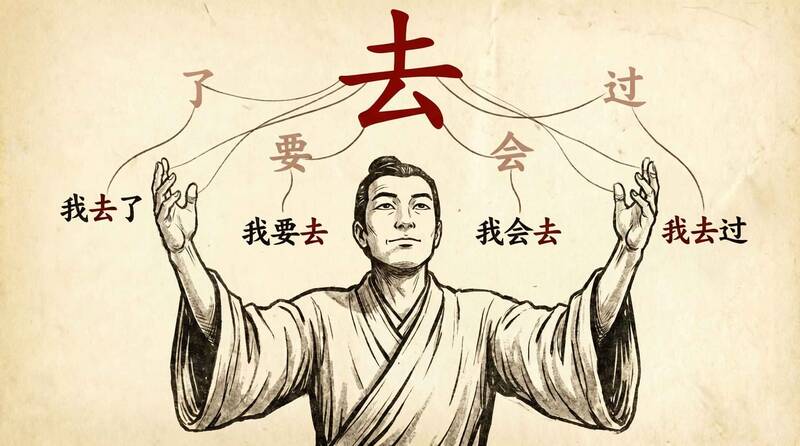
Time is expressed through particles not by changing the verb.
去 never changes. The particles do the work.
Chinese does express time. But it does so through small separate particles, not by modifying the verb itself.
了 (le) — completed action. 我去了 — I went.
要 (yào) — intention or near future. 我要去 — I am going to go.
会 (huì) — future likelihood. 我会去 — I will go.
过 (guò) — past experience. 我去过 — I have been there before.
In all four sentences, 去 stays identical. The particle does the time work — not the verb. Compare that to English where “go” becomes “went” or “have gone” and you have to memorise each form separately.
No gendered nouns.
In Arabic, every noun is masculine or feminine — and every adjective and verb connected to it must agree. In Chinese, grammatical gender does not exist. 书 is just book. Not masculine book or feminine book.
No irregular plurals.
In Arabic, many words have a broken plural that changes the internal structure of the entire word — each one essentially a new word to memorise. In Chinese the noun never changes for quantity. 书 means book. It also means books.
No articles.
No “the.” No “a.” No “an.”
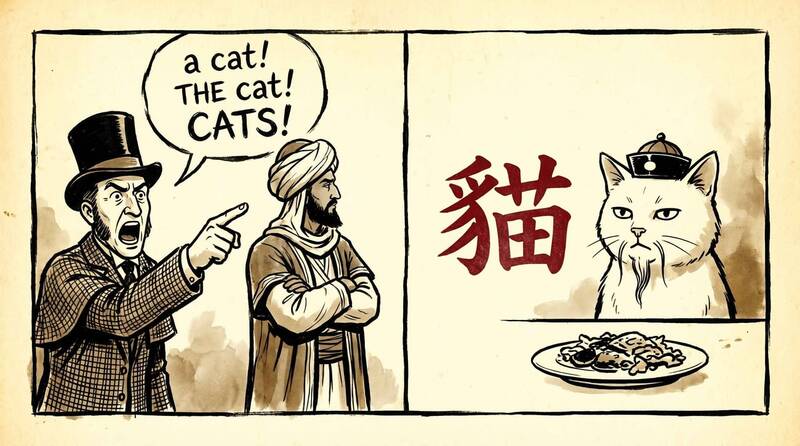
You simply say the noun. 猫 — māo.
The cat. A cat. Cats.
All of it is just 猫.
The writing system is hard. The tones take practice. The vocabulary starts from zero. But none of those are grammar challenges. Most people quit before they ever get to the grammar — and miss the part that would have kept them going.
Quite simple, actually.