 Falafel in Hotpot
Bridge • Issue 05
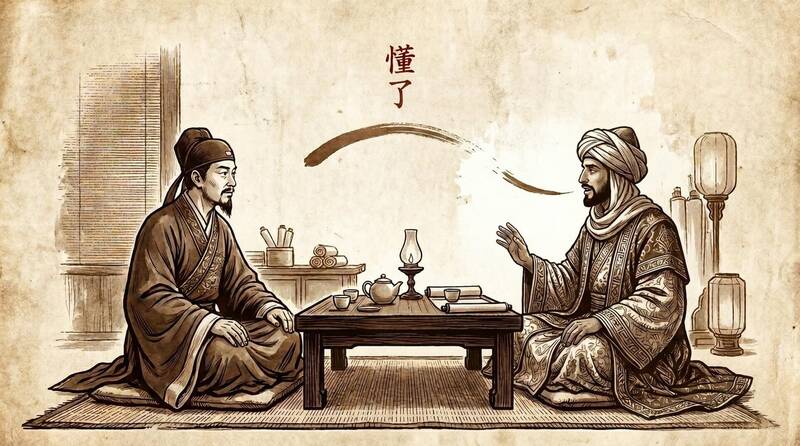
They never said no
China and the Arab world have something in common that nobody ever taught you.
لم يقولوا لا أبداً. لكن الجواب كان دائماً لا.
China and the Arab world have something in common that nobody ever taught you.
Neither of us says what we mean directly.
And I do not mean that as a criticism. I mean it as one of the most important things you can understand about both cultures — and about why people who work between them get confused so often.
There is a concept in anthropology called high-context communication. It was described by an American researcher named Edward Hall in 1976. He divided the world’s cultures into two types.
Low-context cultures — like Germany, the Netherlands, the United States — put everything in the words. The meaning is explicit. If you want something, you say it. If you disagree, you say that too. What is spoken is what is meant.
High-context cultures are different. The meaning is not just in the words. It is in the tone. The timing. The silence. The relationship between the speaker and the listener. A hundred unspoken signals that both parties understand without ever discussing them.
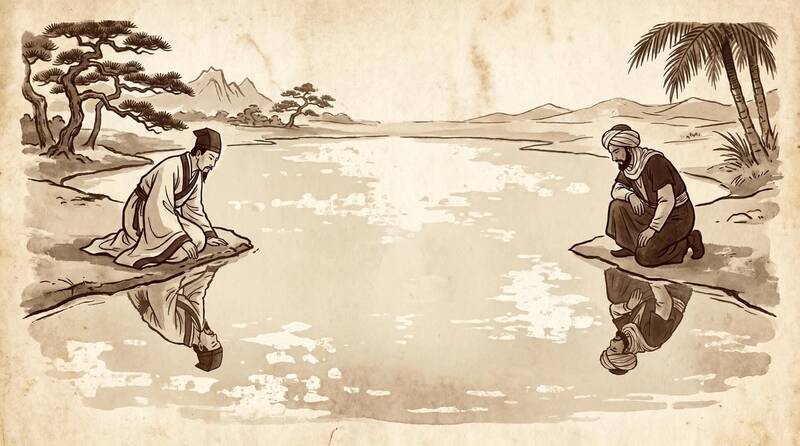
Two civilizations, on opposite ends of Asia, that developed completely independently — and both arrived at the same fundamental conclusion about how human beings should communicate with each other. Not everything that is true needs to be said out loud.
The yes that means no
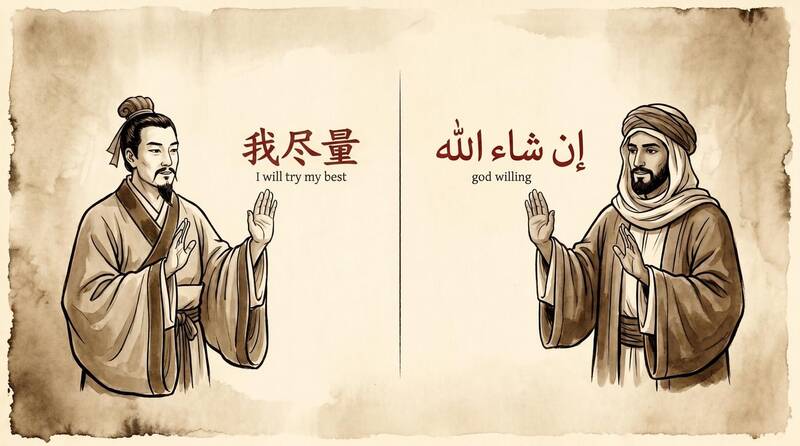
In Chinese, when someone says 我尽量 — wǒ jǐn liàng — it literally means “I will try my best” or “I’ll do as much as I can.” On the surface, it sounds positive and willing. But what it actually means in real life is often: “I’ll try, but don’t count on it.” or “The chances are low.”
It’s a soft, polite way of saying “probably not” without giving a direct “no.” Chinese people use this phrase a lot when they want to be kind and avoid disappointing someone outright, but they also don’t want to make a firm promise. So when you hear 我尽量, it’s best to prepare for the possibility that it might not happen.
But they will never say that directly. Because saying no out loud creates awkwardness. It puts the other person in a position they cannot recover from gracefully. And in Chinese culture, protecting the other person’s face — 面子 — is more important than being blunt.
Arabic does the exact same thing. إن شاء الله — inshallah — is the most famous example in the world. Three words that carry yes, maybe, and no depending entirely on tone, context, and the relationship between the speakers.
A confident inshallah from someone who wants to be there is a real commitment. A soft, trailing inshallah from someone who does not want to disappoint you is a graceful no wrapped inside hope. And everyone in the room who grew up inside the culture hears exactly which one it is.
What this costs people who do not know
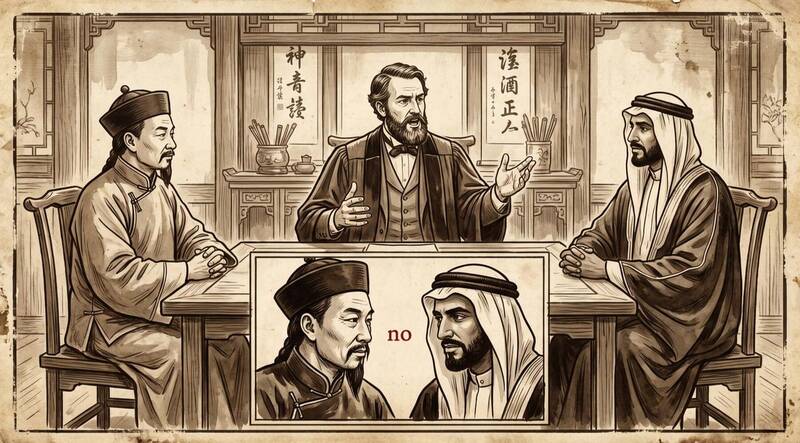
When a Western businessperson sits across from a Chinese or Arab counterpart, they are listening to the words and taking them at face value. They are not trained to hear the silence. They do not catch the shift in subject. They miss the pause that says everything.
So when a Chinese executive says “we will need to study this further” — which means no — a Western counterpart writes in their notes: still in discussion, follow up next week. When an Arab host says “of course, inshallah, we will make it work” — in a tone that every Arab in the room understood as polite deflection — the Western guest flies home feeling confident about a deal that was never going to happen.
And then they come back confused and frustrated and say: I do not understand, they seemed so enthusiastic. They were enthusiastic. About you. About the relationship. About the hospitality. About the deal? The answer was always no. You just did not know how to hear it.
The ease that nobody can explain
Here is what I find most interesting about all of this.
When a Chinese person and an Arab person sit across from each other — even if they share no common language — there is often a wordless ease. A shared understanding that not everything needs to be said. That silence is not awkward. That a graceful non-answer is an answer. That the relationship is the message.
That ease is not an accident. It is two high-context cultures recognising each other. Two people who grew up reading the room, fluent in the language underneath the language, finally meeting someone who speaks it too.
And that is one of the reasons I believe the relationship between China and the Arab world has always had a floor underneath it. Even when the words were different. Even when the history was complicated. The way they communicate has always been, underneath everything, the same.