 Falafel in Hotpot
Learn • Issue 02
Four tiny words. Infinite personality
It is not a mistake. It is not an accent thing. It is a habit so deeply wired into how Chinese people communicate that it follows them even when they switch…
It is not a mistake. It is not an accent thing. It is a habit so deeply wired into how Chinese people communicate that it follows them even when they switch languages.
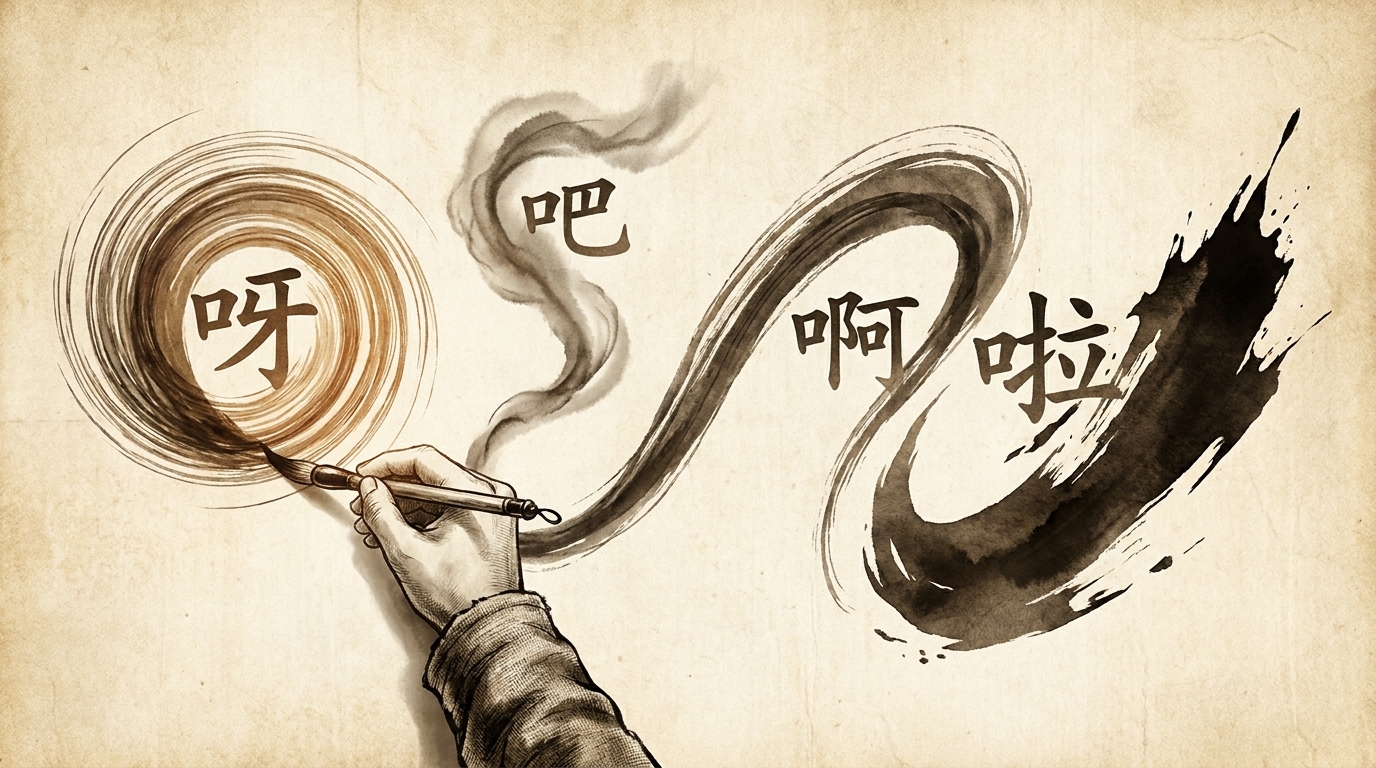
That la — and the words like it — are called 语气词 — yǔqì cí — mood particles. They sit at the end of a sentence and carry something no dictionary word can carry. The feeling behind what was just said.
No translation. No direct equivalent. Just pure emotional colour added to whatever you just said. The four you need to know are these:
呀 — ya · Warm & Surprised
VIBE — WARM · EXCITED · FRIENDLY
Adds a light, warm, or surprised energy. Softens a sentence and makes it sound friendly. You will hear it constantly from native speakers.
吧 — ba · Suggesting & Checking
VIBE — ASSUMING · SUGGESTING · INVITING
Turns a statement into a soft suggestion or assumption. Says: I think this is true, right? Or: let's do this, okay? One of the most useful particles in daily conversation.
啊 — a · Natural & Emphasising
VIBE — EMPHASISING · REASSURING · FLOWING
The most neutral of the four. Adds gentle emphasis or makes a sentence feel more natural. Without it, sentences can sound blunt or cold. With it, they breathe.
啦 — la · Done & Announcing
VIBE — DONE · CHANGED · RELIEVED · FINAL
了 and 啊 combined. Announces that something has happened or changed — with feeling. Carries a sense of finality, relief, or excitement about something new.
Take 好 — and watch what happens when you add each particle:
THE SAME WORD — FIVE COMPLETELY DIFFERENT PEOPLE
- 好 Hǎo Okay. Neutral. A little flat.
- 好呀 Hǎo ya Sure! Warm, friendly, excited.
- 好吧 Hǎo ba Fine, I guess. Reluctant agreement.
- 好啊 Hǎo a Great! Genuine enthusiasm.
- 好啦 Hǎo la Okay okay! Slightly impatient, done discussing.
This is what makes Chinese feel alive. And this is what textbooks almost never teach you.
Say this sentence four times — once with each particle. Feel how the mood shifts each time.
我们走 + 呀 / 吧 / 啊 / 啦
Wǒmen zǒu ya / ba / a / la
Which one felt most natural? Which one felt impossible? Reply and tell me — I read every single one.