 Falafel in Hotpot
Bridge • Issue 17
The name before "Arabia": 大食
A Tang-dynasty mistranslation, three color-coded caliphates, and the word Mecca didn't have yet.
داشي : اسم العرب قديماً
If you read Chinese and saw 大食 for the first time with no context, you’d probably read it the way I did — big — 大 — and eat — 食. “Big Food.”
Maybe a restaurant name. Maybe someone’s nickname for their favorite uncle.
It’s neither. 大食 — Dàshí — is the word Tang dynasty China used for Arabia. For thirteen centuries before “Arabia” ever showed up in a Chinese textbook, this was the name. And it has nothing to do with food at all.
A word that was never meant to mean anything
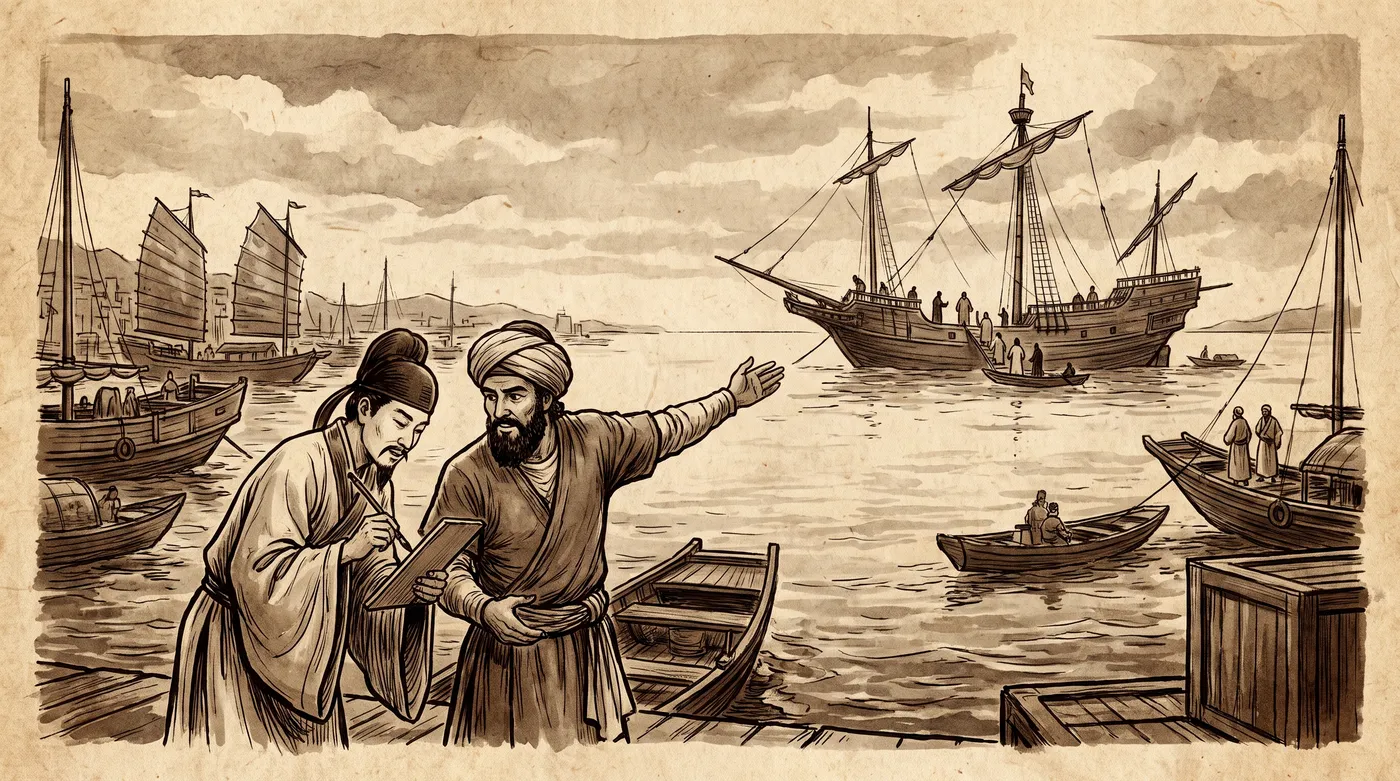
Here’s the part I love: 大食 isn’t a description. It’s not “the land of big eaters” or some Tang-era joke about hospitality. It’s a transliteration — Tang scribes hearing a foreign word and reaching for Chinese characters that sounded close enough, the same way “Mandarin” itself is really just a European ear doing its best with a Portuguese guess at a Chinese term.
The word they were trying to capture was something like Tāzī, or Tajik — the Persian version of the name of a specific Arab tribe, the Ṭayyi’. Persian merchants were the ones bringing word of Arabia into China along the Silk Road, so China got the story through a Persian accent first. 大食 was simply the closest sound Chinese characters could make to what Persian traders were calling the Arabs.
The characters were picked for sound, not sense. 1,300 years of unintentional comedy.
One word, three colors
By the time Chinese scholars were writing detailed accounts of the Islamic world — merchants and port officials like Zhao Rukuo, who ran maritime trade out of Quanzhou in the 1200s — 大食 had actually gotten specific. Specific enough to color-code:
Chinese chroniclers weren’t just aware that “Arabia” existed. They were tracking which caliphate was currently in power, by the color of its ceremonial dress, from thousands of miles away. That’s not a vague foreign land in someone’s imagination. That’s someone taking notes.
A detail worth sitting with
Mecca didn’t get its own Chinese name until 1236, when it shows up as 天方. Possibly the most beautiful mistranslation on this entire list.
Why I keep coming back to this word
I think about 大食 every time someone asks me why I care so much about the China-Arab connection, as if it’s a new idea I invented in Riyadh last year.
It isn’t. It’s 1,300 years old. Tang dynasty merchants were writing detailed, evolving accounts of Arab caliphates while most of Europe wouldn’t have been able to place Arabia on a map. The relationship didn’t start with Belt and Road summits or GCC trade delegations. It started with traders, travelers, and scribes doing their honest best to write down a sound they’d heard from someone who’d heard it from someone else — and getting “Big Food” instead of “Arabia.”
Go one layer deeper
The 1225 text where a Song dynasty port official cataloged over twenty distinct Arab and Central Asian polities. One of the earliest surviving pieces of genuinely detailed Chinese knowledge of the Arab world — written by a customs officer, not a diplomat.